Article
π-Extended Bisallyls Through Valence Isomerism: From Transient Diradicals to Persistent Anions
Piotr Semanyszyn, T. Lis, P. J. Chmielewski, Marcin Stępień
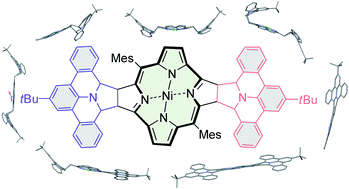
Bisallyl diradicals are central intermediates in allene dimerization, yet they are normally too short-lived to observe under thermal conditions. Here, π-extension of Staudinger-type allene dimers weakens the central cyclobutane bond sufficiently to make reversible ring opening accessible near room temperature. Variable-temperature NMR spectroscopy and ROESY exchange correlations reveal repeated cleavage and reformation of this bond, with activation free energies of 15.77 and 13.79 kcal mol−1 for the Staudinger dimer and its π-expanded analogue, respectively. Calculations reproduce this trend and identify low-population open-shell singlet bisallyls as the intermediates, while explaining the absence of neutral-state EPR signals. Reduction reverses the relative stability of the closed and open valence isomers. Voltammetry and chemical reduction support a sequence of ring-opened radical-anion, dianion, and tetraanion states. The dianion is characterized by NMR spectroscopy and x-ray diffraction, while spectroscopy and calculations reveal progressive bond redistribution from mixed-valence allyl-radical/allyl-anion character to two allyl-anion units and, finally, four fluorenyl-anion-like termini. These results connect hidden neutral diradicals with persistent reduced bisallyl frameworks through charge-controlled covalent-bond reorganization.